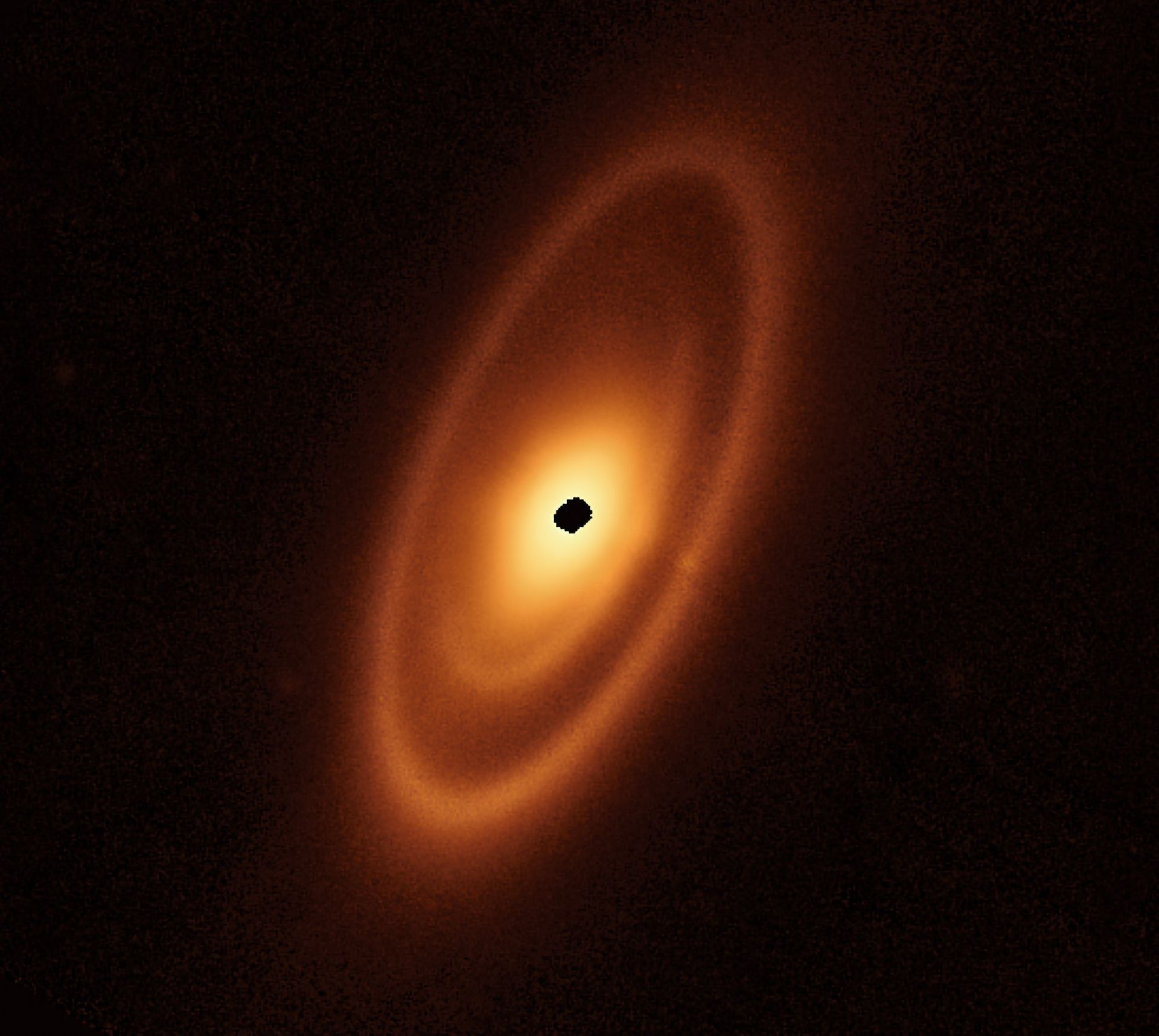
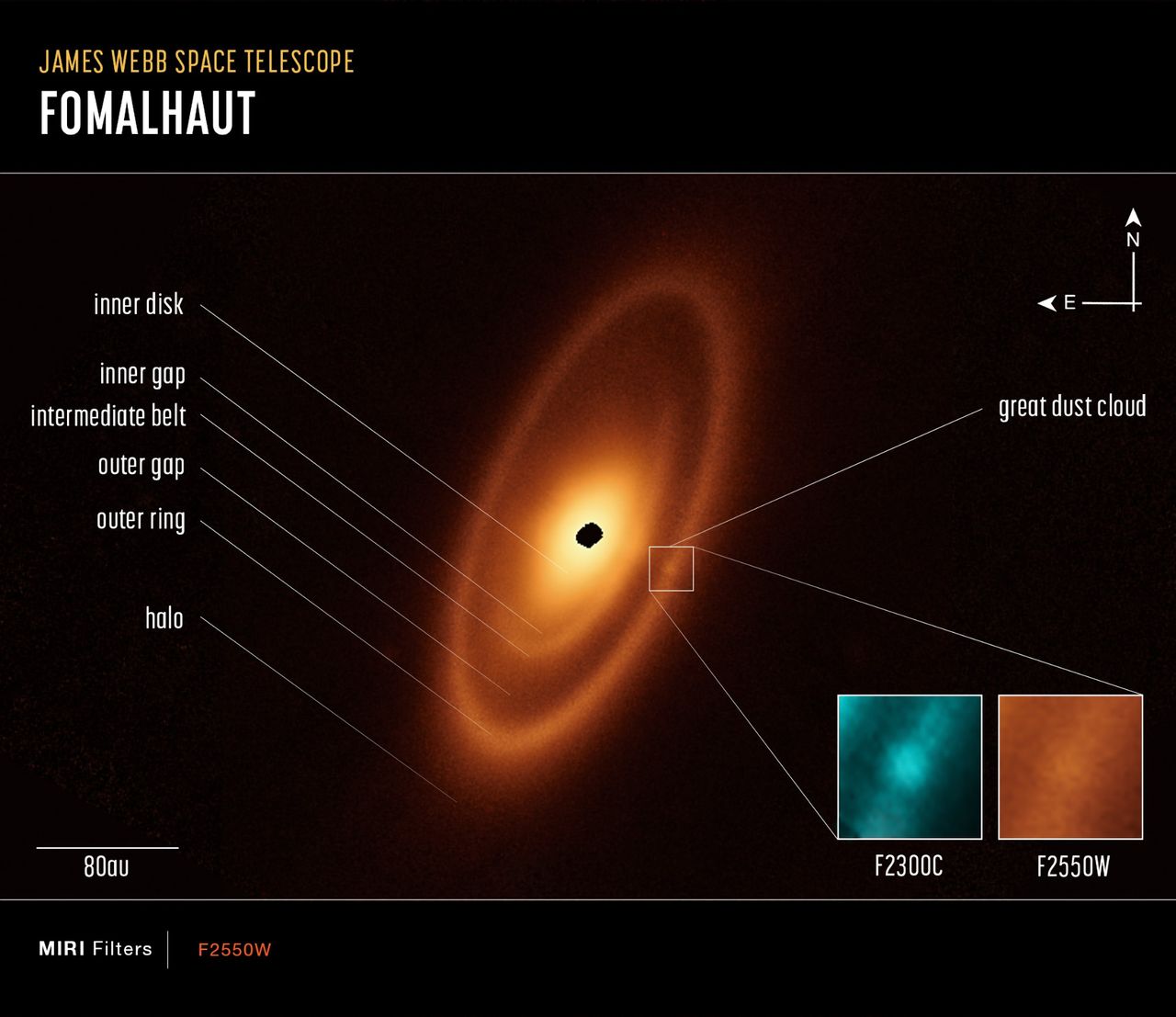
Foto: NASA, ESA, CSA, A. Pagan (STScI), A. Gáspár (University of Arizona)
James Webb captures asteroid belt around planet Fomalhaut
Much larger than our own Kuiper Belt
Astronomers have used the James Webb Space Telescope (JWST) to take a look at an asteroid belt outside our own solar system for the first time in infrared light. This is a massive asteroid belt that surrounds the relatively young star Fomalhaut, which is located about 25 light-years from the Sun in the constellation Pisces Austrinus.
The asteroid belt around Fomalhaut is larger and more complex than our own Kuiper Belt
In a press release, the astronomers write that the asteroid belt around Fomalhaut is both larger and more complex than the Kuiper Belt that orbits our own star, the Sun:"But to their surprise, they found that the dusty structures are much more complex than the asteroid and Kuiper dust belts of our Solar System. Overall, there are three nested belts extending out to 23 billion kilometers from the star — that’s 150 times the distance of Earth from the Sun. The scale of the outermost belt is roughly twice the scale of our Solar System’s Kuiper Belt of small bodies and cold dust beyond Neptune. The inner belts — which had never been seen before — were revealed by Webb for the first time."
Astronomers suspect that the structure of the belt has been influenced by undiscovered planets
So far, astronomers have not been able to detect any planets around Fomalhaut. However, they suspect that the structure of the asteroid belt around the star is due to the gravity of as-yet-undiscovered planets, in a similar way to how the Kuiper Belt has been influenced by the gravity of Neptune.
Researchers plan to study Fomalhaut more closely to find any planets around the star
To find any planets around Fomalhaut, astronomers will now study images of the star more closely. It is believed that there may be three or more planets around the star that are the size of Uranus and Neptune.
esawebb.org
Science,
James Webb Space Telescope,
Fomalhaut,
asteroid belt,
Kuiper Belt,
undiscovered planets
Foto: NASA, ESA, CSA, A. Pagan (STScI), A. Gáspár (University of Arizona)
37.0°
0Wille Wilhelmsson
tis. 9 maj 2023, 09:00
+
Per månad
39 kr
Betala löpande per månad. Ingen bindningstid.
Starta prenumeration
Per år
299 kr
Enklast och billigast, bara 25 kronor i månaden. Betala löpande per år. Ingen bindningstid.
Prova 14 dagar gratis innan du bestämmer dig.
Starta gratis provperiod
Engångsköp
349 kr
Slipp återkommande betalningar, betala ett år i taget. Betala med kort eller Swish.
Köp utan prenumeration